class: center, middle, inverse, title-slide # Statistics: Rules and Pitfalls ## Biodata Club <div style='float:left'> <hr color='#EB811B' size=1px width=720px> </div> <p><br></p> ### Jessica Minnier, PhD <br> Assistant Professor of Biostatistics, OHSU-PSU SPH <br> <i class="fa fa-twitter fa-fw"></i> <span class="citation">@datapointier</span> ### March 2, 2018<br><br> Slides available at <a href="http://bit.ly/biodata-stats" class="uri">http://bit.ly/biodata-stats</a> --- # Topics: ## 1. Big Picture: ["Ten Simple Rules for Effective Statistical Practice"](https://doi.org/10.1371/journal.pcbi.1004961) Kass et al, 2016, PLOS Computational Biology ## 2. Specific Details: ["Common Statistical Pitfalls in Basic Science Research"](http://europepmc.org/articles/PMC5121512) Sullivan et al, 2016, Journal of the American Heart Assocation --- class: center # What is statistics? ### Statistics is not a <font style="color: #EB811B;">hurdle</font> to overcome ### It is not a <font style="color: #EB811B;">recipe</font> -- ### It is a <font style="color: #EB811B;"> framework for doing science </font> ### It is a <font style="color: #EB811B;"> language ("with probability its grammar") </font> -- ### It informs: ###<font style="color: #EB811B;">design + data generation + model + analysis + inference + design next study</font> --- # Rule 1, Methods work *with* the data ### Statistical methods <font style="color: #EB811B;"> enable data </font> to answer scientific Q's - We want to <font style="color: #EB811B;">answer a scientific question</font>, not *just* analyze the data because it <font style="color: #EB811B;">looks a certain way</font> (method should not be based on just data structure) - Not <font style="color: #EB811B;">"Which test should I use?"</font>, but <font style="color: #EB811B;">"How can the data provide answers?"</font> (statistical test, different type of test, visualization, clustering), i.e. "Where are the differential genes?" -- - Statistical experts are <font style="color: #EB811B;">collaborators</font> that + identify potential sources of <font style="color: #EB811B;">variability</font> + look for <font style="color: #EB811B;">"hidden realities"</font> that might mean the data can't answer your question + then develop analytic goals and strategies - Statistical planning and collaboration needs to start <font style="color: #EB811B;">EARLY</font> (see Rule 3) ### <font style="color: #EB811B;">Practice Team Science!</font> --- # Example: ### 2 groups, continuous variable; easy, right? - <font style="color: #EB811B;">T-test!(?)</font> -- - Not if there's <font style="color: #EB811B;">correlation</font> in the data, or confounder(s), or mismeasured outcomes - What if the data are <font style="color: #EB811B;">matched</font> and you want to know if the variables move in the same direction/correlate? + T-test is the wrong answer (just estimate correlation!) --- # Variability ### Rule 2: <font style="color: #EB811B;">Signals always come with noise</font> - Statisticians are trained to look for and deal with variability - Models simplify patterns to <font style="color: #EB811B;">describe variability</font> to be able to detect signal - Big data make these issues worse! -- ### Rule 7: <font style="color: #EB811B;">Provide Assessments of Variability</font> - Almost all measurements have uncertainty (estimate it!) - <font style="color: #EB811B;">Careful!</font> need to take into account <font style="color: #EB811B;">dependencies in data</font>, or else <font style="color: #EB811B;">SEs are wrong</font> - Batch effects increase variability - Big data is not a substitute for large `\(n\)` (careful when estimating SE and n) --- # Example: Sample Size ### What's my `\(n\)`? - Sample size/power calculations <font style="color: #EB811B;">depend on variability</font> + biological variability + technical variability + sampling variability + but this is often unknown, so consider a <font style="color: #EB811B;">range of values</font> - Dependence structure in the data `\(\rightarrow\)` this will change the `\(n\)` + i.e. repeated measures, clustering, family/relatedness, matching --- # Don't Waste Your Money ### Rule 3: <font style="color: #EB811B;">Plan Ahead, Really Ahead</font> - Not just "what should my n be?" - Statisticians are trained to look at the <font style="color: #EB811B;">big picture</font> and <font style="color: #EB811B;">look for future problems</font> in data collection, processing, analysis, inference (can we "design out" the problems?) ### Rule 4: <font style="color: #EB811B;">Worry about Data Quality</font> - Pre-processing, data cleaning, how did this data get here? - <font style="color: #EB811B;">Careful!</font> Why is this data <font style="color: #EB811B;">missing?</font> --- # Ex: Problems you may not anticipate ### Outcome troubles - Your outcome measure is <font style="color: #EB811B;">too variable</font> or measuring what you want in a biased way - <font style="color: #EB811B;">Too many outcome measures</font> to detect meaningful effects after multiple testing correction ### Structure in your data - <font style="color: #EB811B;">Batch effects</font> - Sample size assuming <font style="color: #EB811B;">independence</font> could be incorrect ### Design - Is your goal hypothesis testing, or is it actually <font style="color: #EB811B;">estimation?</font> - How to <font style="color: #EB811B;">randomize, stratify</font>, identify how to <font style="color: #EB811B;">remove bias and confounding</font>? --- # Modeling ### Rule 5: <font style="color: #EB811B;">Statistics `\(>\)` Set of Computions</font> - Always <font style="color: #EB811B;">EXPLAIN</font> how the methods help you answer the biological question (why did you pick that method?) - Code knowlege `\(\neq\)` statistics knowledge ### Rule 6: <font style="color: #EB811B;">Keep it Simple (KISS)</font> - Often provide the strongest results, also interpretability - <font style="color: #EB811B;">Careful!</font> curse of overfitting (not generalizable) --- # Rule 8: Check Assumptions ### <font style="color: #EB811B;">The Big Ones:</font> - Normality - Independence - Missing Data (bias related to missingness not at random) -- ### <font style="color: #EB811B;">Careful!</font> - Some models/tests are more <font style="color: #EB811B;">robust</font> to deviations than others - <font style="color: #EB811B;">Skewness</font> can give you very weird results - Systematic <font style="color: #EB811B;">bias</font> (i.e. in sampling) - Visual checks (i.e. plot residuals from a regression) - You may need: <font style="color: #EB811B;">nonparametric</font> analysis, <font style="color: #EB811B;">survival</font> analysis, <font style="color: #EB811B;">longitudinal</font> analysis --- # Ex: Parametric vs Non-parametric Tests? ### Often <font style="color: #EB811B;">misunderstood</font> - T-tests assume <font style="color: #EB811B;">normality of the population</font>, but in *large* samples the central limit theorem usually "kicks in" since distribution of means are usually normal (but again, unders assumptions! independence!) + <font style="color: #EB811B;">Ratios</font> or "fold changes" are not normally distributed - Wilcoxon test or other common nonparametric tests do not assume normality, but you are <font style="color: #EB811B;">no longer testing means (nor medians, unless specific assumptions are met)</font> + outcome: ordinal or interval + can have lower power in small samples, but more conservative - Common nonparametric tests often performed by replacing data with <font style="color: #EB811B;">ranks</font> --- # Practice Sound Science ### Rule 9: <font style="color: #EB811B;">When Possible, Replicate!</font> - P-hacking, overtesting, overselecting, overfitting --> results cannot stand the test of time (replication) - Replicate using <font style="color: #EB811B;">new data</font> - Know your <font style="color: #EB811B;">limitations</font> (small sample, biased sampling, unmeasured confounding) and remove those issues next time. Learn from your study! ### Rule 10: <font style="color: #EB811B;">Make Your Analysis Reproducible</font> - <font style="color: #EB811B;">Minimum standard</font> - Given same data, description of analysis --> reproduce all results/tables/figures - Use reproducible code tools (i.e R Markdown), version control (i.e. git) --- # Example: Multiple testing ### Scary but real - Each test has a <font style="color: #EB811B;">nonzero (likely 5%) probability of incorrectly claiming significance</font> - Each test you make <font style="color: #EB811B;">increases this error rate</font> - Know what type I error and False Discovery Rate (FDR) and Family-Wise Error Rate (FWER) <font style="color: #EB811B;">mean and what the differences are</font> - If you want to relax the error rates, <font style="color: #EB811B;">you are doing an *exploratory* study</font>. No denial. Now, replicate! --- # Misc. Errors to Avoid - Acknowledge the ways the <font style="color: #EB811B;">data are SELECTED</font> prior to formal analyses - Do not use the <font style="color: #EB811B;">same data set to both generate and test hypotheses</font> - Relatedly, practice <font style="color: #EB811B;">safe EDA</font> (exploratory data analysis) + Use EDA to visualize distributions and look for outliers or possible model misspecifications, but [don't choose which hypotheses to test after EDA](https://en.wikipedia.org/wiki/Testing_hypotheses_suggested_by_the_data) (unless your study is truly exploratory) - Use <font style="color: #EB811B;">dot plots</font> when you have small samples (not bar plots, or even just boxplots) 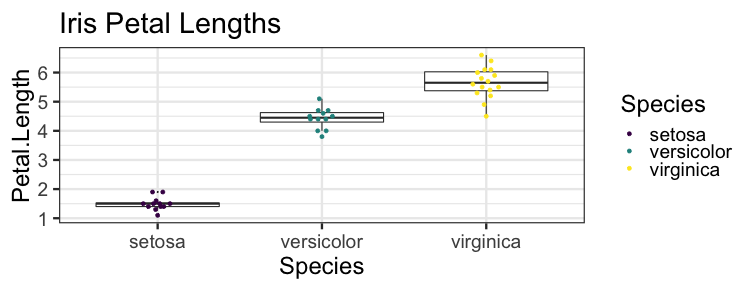<!-- --> --- # Similar Articles/References - Harrel, Frank. [Manuscript Checklist](http://biostat.mc.vanderbilt.edu/wiki/Main/ManuscriptChecklist) on Vanderbilt Biostatistics website. - Wicherts, Jelte M., et al. ["Degrees of freedom in planning, running, analyzing, and reporting psychological studies: A checklist to avoid p-hacking."](https://www.frontiersin.org/articles/10.3389/fpsyg.2016.01832/full) Frontiers in Psychology 7 (2016): 1832. - Marino, Miguel. ["Reflections from a statistical editor: elements of great manuscripts."](http://www.annfammed.org/content/15/6/504.short) (2017): 504-506. - Zinsmeister, Alan R., and Jason T. Connor. ["Ten common statistical errors and how to avoid them."](https://www.nature.com/articles/ajg20085055) The American journal of gastroenterology 103.2 (2008): 262. - Altman, Douglas G., and J. Martin Bland. ["Improving doctors' understanding of statistics."](http://www.jstor.org/stable/2983040) Journal of the Royal Statistical Society. Series A (Statistics in Society) (1991): 223-267. --- background-image: url(phackingchecklist.png) # Checklist avoid p-hacking, Wicherts et al --- # Resources on Campus Biostatistics and Design Program (BDP) - Email bdp@ohsu.edu - Campus-wide (University Shared Resource) - Drop in hours on Tuesday - Can use Dean’s award or USR awards to pay for core services for grants - https://www.ohsu.edu/xd/research/research-cores/bdp.cfm Knight Cancer Institute Biostatistics Shared Resource (BSR) - For Knight Cancer Institute members/investigators - Pre-award help is subsidized - Submit project request: https://bridge.ohsu.edu/research/knight/resources/BSR/SitePages/Project%20Requests.aspx West Campus: BBU Biostatistics and Bioinformatics Unit - Email Suzi Fei - http://www.ohsu.edu/xd/research/centers-institutes/onprc/research-services/research-support/Biostatistics-a-Bioinformatics.cfm --- # Courses at OHSU School of Public Health Courses - BSTA 523 Design of Experiments + Statistical principles of research design and analysis - PHPM 524 Introduction to Biostatistics - PHPM 525/BSTA 511 Biostatistics I: Estimation and Hypothesis Testing in Applied Biostatistics Human Investigations Program (HIP) - HIP 528 and 529: Applied Biostatistics I and II CSEE Computer Sci/Electrical Engineering - Data Science classes - MATH 530/630 Probability & Statistical Inference for Scientists and Engineers --- # Learn Statistics - [Modern Dive](http://moderndive.com/) An Introduction to Statistical and Data Sciences via R - Chester Ismay & Albert Kim - [Biostatistics for Biomedical Research](http://www.fharrell.com/doc/bbr.pdf) - Frank E Harrell Jr & James C Slaughter, from [ClinStat Class at Vanderbilt](http://biostat.mc.vanderbilt.edu/wiki/Main/ClinStat) - Coursera, edX, Data Camp --- # Thank you! <br> Contact: <i class="fa fa-envelope fa-fw"></i> minnier-[at]-ohsu.edu, <i class="fa fa-twitter fa-fw"></i> [datapointier](https://twitter.com/datapointier), <i class="fa fa-github fa-fw"></i> [jminnier](https://github.com/jminnier/) Slides available at <font style="text-transform: lowercase;"><http://bit.ly/biodata-stats></font> <br> Code for slides available at <https://github.com/jminnier/talks_etc> Slides created via the R package [xaringan](https://github.com/yihui/xaringan) by [Yihui Xie](https://twitter.com/xieyihui?lang=en) with the metropolis theme